
If you’ve ever stared at a water stain spreading across your drywall or cleaned up a yard full of blown-off shingles after a tropical downpour in Florida, you’ve likely run headfirst into one of the most debated topics in Sunshine State real estate: the 25% roof rule.
Homeowners naturally assume that if storm winds tear up a corner section of their roof, a local roofer can simply patch the damage and move on. But because of Florida’s stringent building codes and wind-mitigation mandates, crossing a specific damage threshold can turn a simple $1,000 repair into an unexpected, mandatory full-system replacement.
Whether you are budgeting for local contractor rates in Jacksonville, comparing shingle vs. metal options in Orlando, or navigating insurance claims in Tampa, understanding how this statute works will protect you from major financial surprises.
Need a Professional Cost Breakdown?
Calculate exact material expenses, local permit fees, and labor projections instantly using our interactive Florida roofing cost calculator.
<a href="/cost/roof-replacement/" className="shrink-0 inline-flex items-center gap-2 bg-sky-600 hover:bg-sky-700 text-white font-bold px-6 py-3 rounded-xl shadow transition text-sm"
What Exactly Is Florida’s 25% Roofing Rule?
The regulation known widely among contractors, adjusters, and homeowners as the "25% Rule" is formally codified in the Florida Building Code (FBC) – Existing Building, Section 706.1.1. In plain terms, the code specifies that if more than 25 percent of the total roof area or an independent roof section is repaired, replaced, or recovered within any rolling 12-month period, the entire roofing system or affected roof section must be brought up to current building codes.
State lawmakers and structural engineers designed this statute to prevent property owners and contractors from repeatedly patching storm-damaged roofs piecemeal over decades. Patching aging framework leaves older homes dangerously vulnerable to catastrophic uplift pressures during subsequent hurricane landfalls. When cumulative repairs cross that quarter-mark threshold on older structures, local building officials will reject partial permit applications, mandating a complete, code-compliant overhaul instead.
The Crucial Exception: Pre-March 2009 vs. Post-March 2009 Roofs
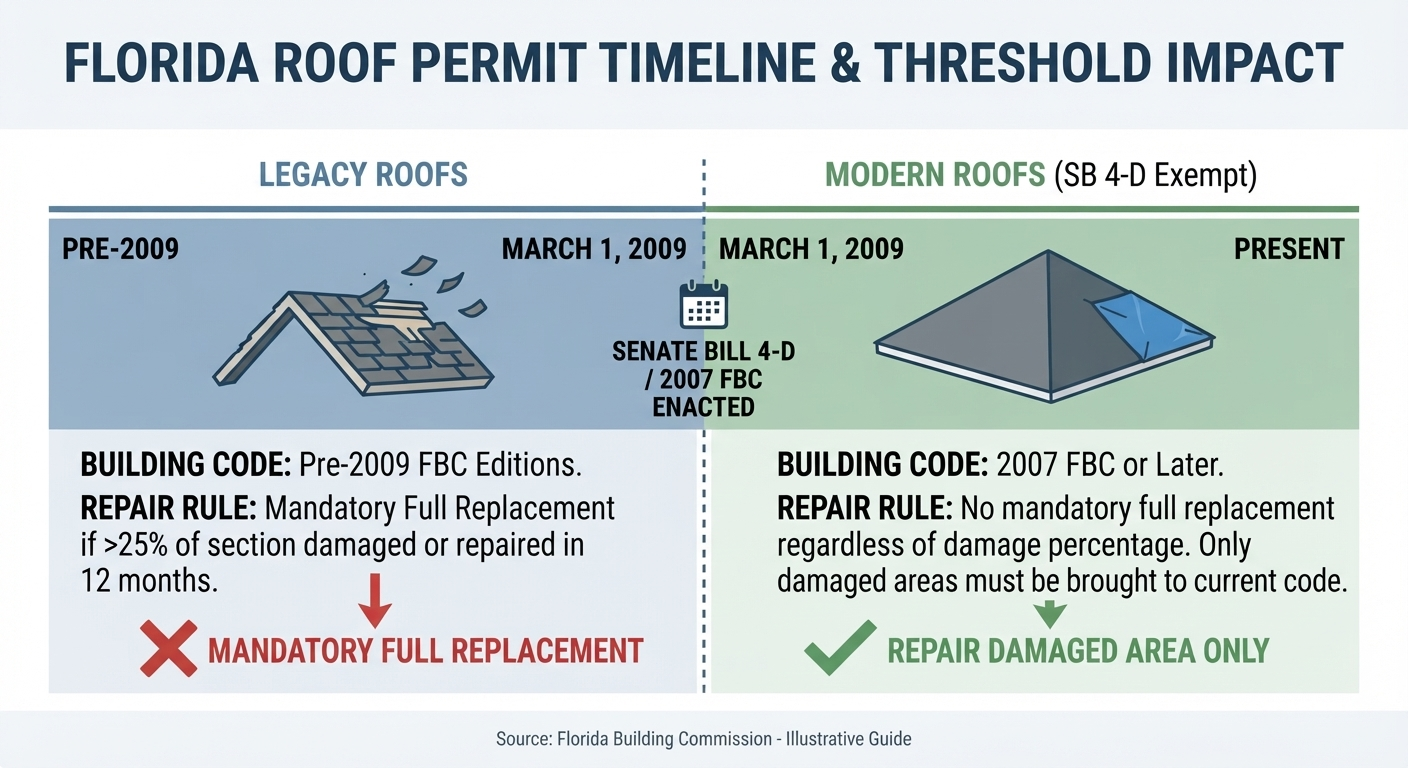
A monumental shift occurred when the Florida Legislature passed Senate Bill 4-D (codified under Fla. Stat. § 553.844(5)), creating a massive regulatory carve-out that protects owners of newer roofs. Determining whether your home qualifies for this exemption depends entirely on when your roof was originally permitted:
- Roofs Permitted On or After March 1, 2009: These structures were built under the 2007 Florida Building Code edition or subsequent revisions. Because modern standards already mandated enhanced deck attachments, secondary water barriers, and high-wind fastening clips, the 25% full-replacement trigger does not apply. If 40% of a post-2009 roof is damaged by wind or hail, you are legally permitted to repair only the damaged section using current code practices without being forced to replace the remaining 60%.
- Roofs Permitted Before March 1, 2009: These legacy roofs pre-date modern wind-mitigation mandates. If cumulative storm damage or repairs exceed 25% of a given roof section within a 12-month window, the mandatory full-replacement rule is strictly enforced.
| Roof Permit Date | Damage Threshold Trigger | Legal Requirement |
|---|---|---|
| Before March 1, 2009 | Exceeds 25% of a roof section in 12 months | Entire section or roof must be replaced to current code |
| On or After March 1, 2009 | Any percentage of damage | Repair damaged area only; full replacement not forced |
How Building Officials Define a "Roof Section"
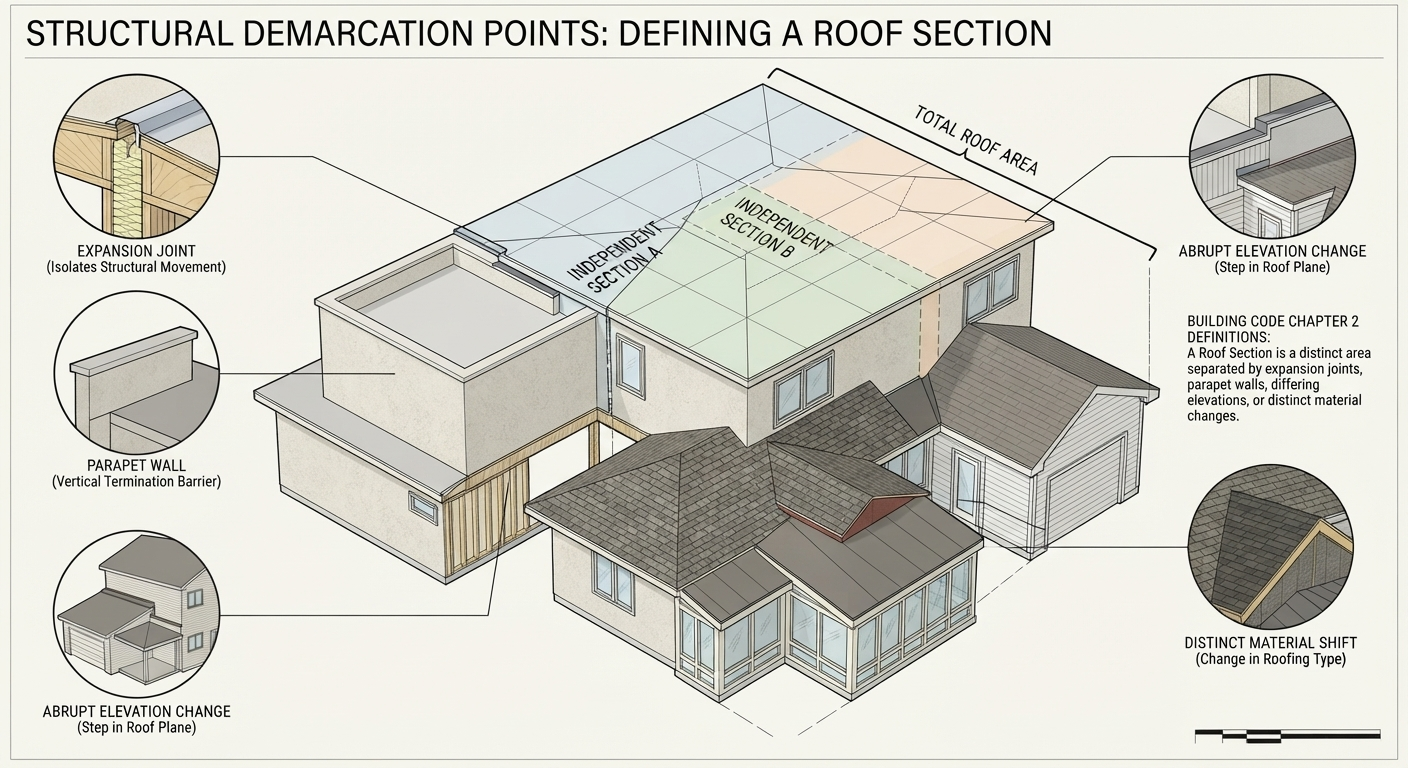
A common misconception among homeowners is that the 25% calculation applies to the total square footage of the entire house footprint. In practice, building departments evaluate thresholds per roof section as outlined in FBC Chapter 2.
An independent roof section is delineated by structural divisions such as expansion joints, parapet walls, abrupt elevation changes, or distinct material shifts (e.g., transitioning from a pitched shingle gable to a flat modified bitumen porch roof or a separate tile turret). For instance, if severe wind tore through 30% of a distinct rear annex slope—amounting to 350 square feet out of a total 2,500 square foot home—that specific section meets the 25% threshold independently, triggering a code-compliant rebuild for that slope even if the front roof slope remains untouched.
Compare Costs Across Florida Metropolitan Areas
Material requirements and municipal permitting fees vary drastically across the state. Review our dedicated regional guides to see exact pricing models:
Insurance Claims, Rolling 12-Month Windows, and "Tie-Off" Rules
Insurance carriers closely scrutinize damage percentages following major weather events. Two vital principles govern how claims are adjusted under Florida statutes:
- The Rolling 12-Month Accumulation: The 25% threshold is cumulative. If a winter storm damages 10% of your roof in February, and a summer tropical system damages another 18% of the same section in August, your total affected area reaches 28% within 12 months, legally triggering a full replacement requirement upon filing the second permit.
- Exclusion of Tie-Off Work: According to Florida Building Commission declaratory statements (such as DS 2021-007), removing and reinstalling undamaged materials solely to connect or tie a repair into existing unaffected areas does not count toward the 25% calculation. Only actual damaged material counts against your threshold.
When a full replacement is mandated by the 25% rule on an older pre-2009 roof, standard Florida homeowner insurance policies typically cover the associated code upgrade costs under Ordinance or Law coverage provisions, provided your policy includes adequate percentage limits (such as 25% or 50% of dwelling coverage). Homeowners are encouraged to review their policy declarations page or consult certified local tax and insurance professionals, such as local CPAs or public adjusters, to verify their specific ordinance limits.
Frequently Asked Questions
What is the 25 percent roof rule in Florida?
The 25 percent rule stems from Florida Building Code, Existing Building Section 706.1.1. It dictates that if more than 25 percent of a roof or roof section is repaired, repaired, or recovered within any 12-month period, the entire roof system or roof section must be brought up to current building codes.
Does the 25 percent rule apply to roofs built after 2009?
Generally, no. Under Florida Statute 553.844(5) (enacted via Senate Bill 4-D), if your existing roof was permitted and installed in compliance with the 2007 Florida Building Code or later (effective March 1, 2009), only the damaged portion needs to be repaired to current code standards, avoiding a mandatory full replacement.
How is a roof section defined under Florida building codes?
Chapter 2 of the Florida Building Code defines a roof section as a distinct area separated by expansion joints, parapet walls, differing elevations, or distinct material changes (excluding standard valleys, hips, and ridges).
Does tie-off or tie-in work count toward the 25 percent threshold?
No. According to Florida Building Commission declaratory statements (such as DS 2021-007), removing and reinstalling undamaged materials strictly to tie a repair into the surrounding roof system does not count toward the 25 percent threshold calculation.
Disclaimer: Sunstate Home Costs provides independent home improvement cost data and contractor insights. Pricing and code interpretations vary based on local municipal amendments and engineering requirements. Always verify local building department guidelines and consult licensed roofing contractors before filing insurance claims.