
You just dropped $12,000 on a high-efficiency heat pump to survive another brutal Florida summer, or maybe $18,000 on impact windows to prepare for hurricane season. When tax season rolls around, your immediate thought is: Can I write off any of this on my tax return?
The short answer is both yes and no. The IRS explicitly prohibits writing off routine repairs or painting on your primary residence. However, Florida homeowners can leverage thousands of dollars in direct 30% IRS tax credits, state sales tax exemptions, and structural cost-basis offsets that slash capital gains when selling.
Before diving into federal tax codes, you can calculate real-world contractor costs with our Jacksonville 2.5 Ton HVAC Cost Estimator or run numbers on our Screened Lanai Cost Calculator.
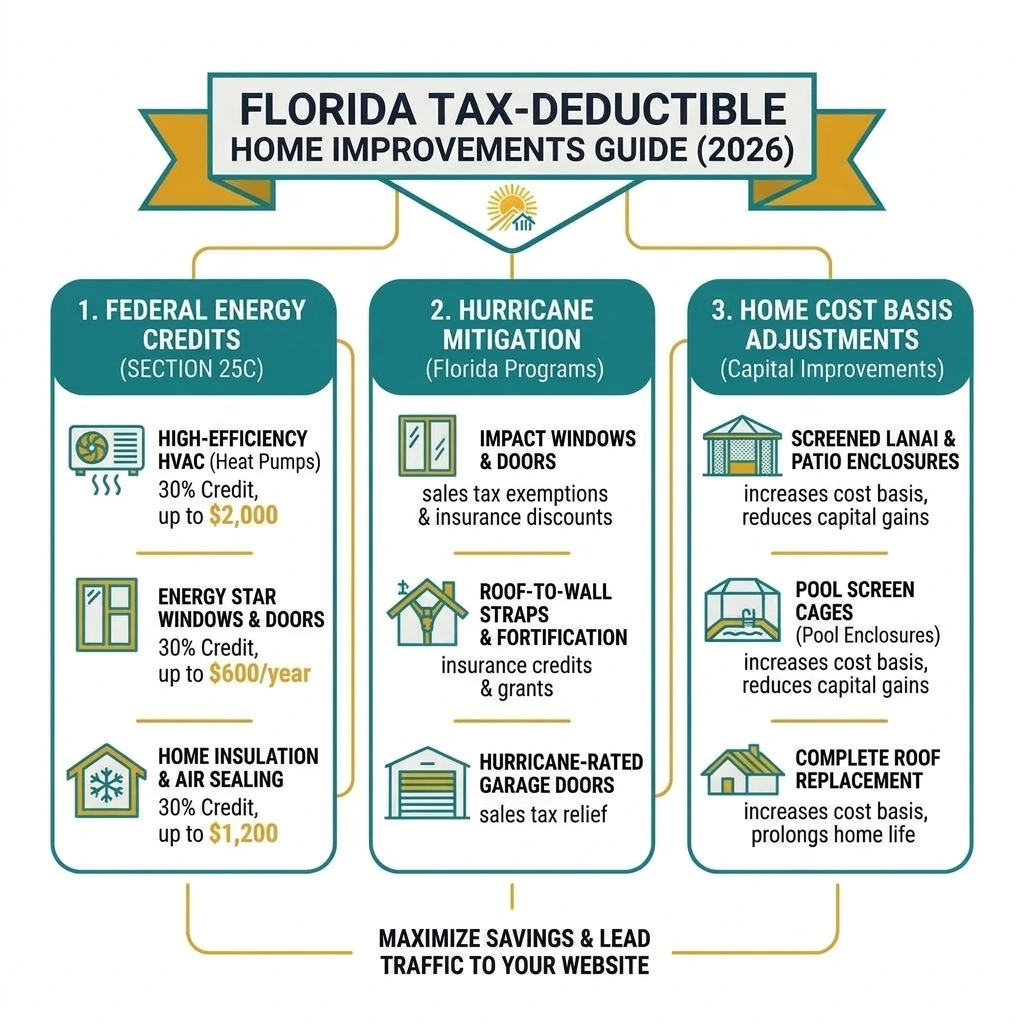
Direct Answer: What Qualifies for Tax Relief in Florida?
Standard maintenance (like patching a roof leak or repainting your living room) is never tax deductible on a primary residence.
However, you can get legitimate, legal tax relief for Florida home upgrades through three primary mechanisms:
- IRS Section 25C Energy Efficient Home Improvement Credit: Up to $3,200 annually in direct tax credits for heat pump HVACs, energy-efficient windows, doors, and electrical upgrades.
- IRS Section 25D Clean Energy Credit: An uncapped 30% tax credit for rooftop solar panel arrays and battery storage systems.
- Home Capital Cost Basis Increases: Adding the cost of permanent capital improvements (screened lanais, pool enclosures, new roofs) to your home's original purchase price to eliminate capital gains tax when selling.
1. Federal Energy Tax Credits (IRS Section 25C)
Under the Inflation Reduction Act rules active for 2026, Florida homeowners can claim a 30% tax credit on qualifying energy-efficiency projects up to an annual maximum of $3,200 per year.
Because this is an annual limit (not a lifetime cap), smart homeowners stagger their installations across multiple calendar years to claim maximum savings.
Qualifying Energy Upgrades & Annual IRS Limits
| Home Improvement Project | Max Annual IRS Credit | Technical Requirements for Florida Homes |
|---|---|---|
| Heat Pump HVAC System | $2,000 | Must meet or exceed ENERGY STAR highest efficiency tier (15.2+ SEER2). |
| Exterior Energy Windows | $600 | Must meet ENERGY STAR Most Efficient criteria for Southern Zone. |
| Exterior Doors | $500 ($250/door) | Must meet ENERGY STAR requirements for entry/patio doors. |
| Electrical Panel Upgrades | $600 | Upgrades to 200A+ panels installed in conjunction with heat pump systems. |
| Home Insulation & Air Sealing | $1,200 | Radiant barrier insulation or blown-in attic insulation meeting IECC codes. |
Why Heat Pumps Dominate Florida Savings
In cities like Jacksonville, Tampa, and Orlando, cooling accounts for over 50% of summer electric bills. Upgrading an ancient 14 SEER system to a high-efficiency 16+ SEER2 variable-speed heat pump qualifies for the full $2,000 Section 25C credit.
Pairing that with local utility incentives—like JEA rebates or FPL energy savings—can shave up to $3,500 off total installed project costs.
You can verify regional property valuation rules using our Florida Building Code & Permitting Guide.
2. Hurricane Mitigation: Windows, Doors & Grants
A frequent question from Duval and St. Johns County homeowners is whether impact windows and storm shutters are tax-deductible.
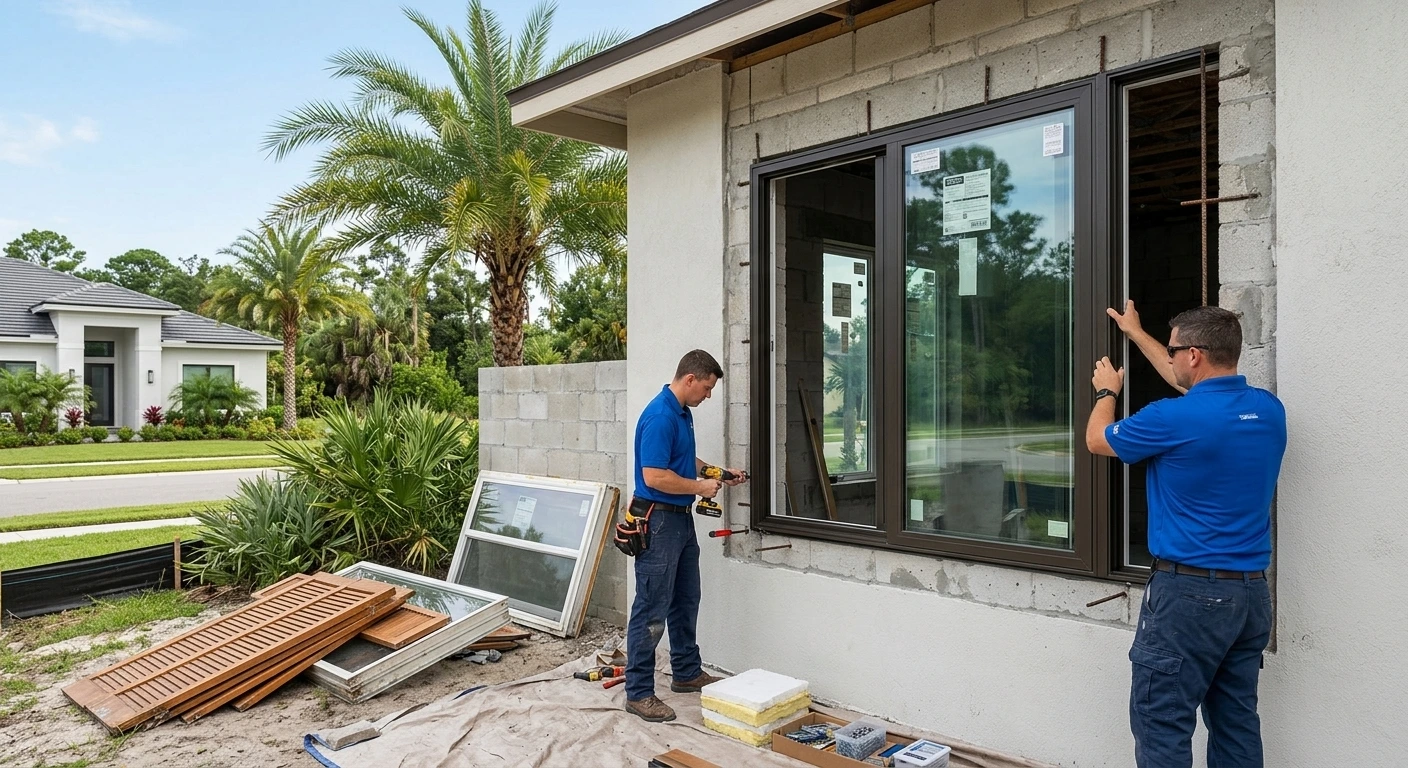
While hurricane protection itself is not a standalone IRS tax deduction, impact-resistant windows double as energy-efficient windows if they feature Low-E coatings and dual-pane insulated glass.
- Federal Tax Savings: High-efficiency impact windows qualify under Section 25C for a 30% tax credit up to $600.
- State Sales Tax Exemptions: Florida periodically enacts sales tax holidays on impact-resistant doors, windows, and garage doors, saving an immediate 6% to 7.5% at purchase.
- My Safe Florida Home Program: Homeowners in participating wind-borne debris regions can secure up to $10,000 in 2-for-1 matching grants for hurricane mitigation (roof-to-wall straps, hurricane-rated garage doors, and impact glass).
3. Capital Improvements vs. Maintenance: Capital Gains Tax Strategy
When you sell your primary residence, federal tax law exempts up to $250,000 in profit for single filers and $500,000 for married couples filing jointly.
Because Florida home values have surged over recent years, many long-term homeowners risk exceeding these exemption thresholds. This is where capital improvements come in.
What Is a Capital Improvement?
A capital improvement is a permanent structural addition or upgrade that adapts a home to new uses, prolongs its useful life, or increases its market value. Every dollar spent on a capital improvement gets added to your home's adjusted cost basis.
$$\text{Adjusted Cost Basis} = \text{Original Purchase Price} + \text{Closing Costs} + \text{Capital Improvements}$$
A higher cost basis directly shrinks your taxable gain when you sell!
Capital Improvement vs. Repair Comparison
| Project Type | Classified as Capital Improvement? | Impact on Home Tax Basis |
|---|---|---|
| Screened Lanai / Patio Enclosure | Yes | Increases basis by full project cost ($6k–$18k+) |
| Pool Screen Cage Installation | Yes | Increases basis by full project cost ($8k–$20k+) |
| Complete Roof Replacement | Yes | Increases basis by full project cost ($10k–$25k+) |
| Replacing Broken Roof Shingles | No (Repair) | Zero impact on basis |
| Installing Central AC / Heat Pump | Yes | Increases basis by full project cost ($4k–$8.5k) |
| HVAC Annual Service / Freon Recharge | No (Maintenance) | Zero impact on basis |
| Interior / Exterior House Painting | No (Cosmetic) | Zero impact on basis |
If you purchased a home in Ponte Vedra for $400,000 and sell it years later for $950,000, your gross gain is $550,000. For a married couple, $50,000 exceeds the $500k exemption limit.
However, if you spent $30,000 on a custom pool enclosure, $15,000 on a new roof, and $10,000 on a screened lanai, your adjusted cost basis rises to $455,000—completely eliminating your capital gains tax liability.
To estimate outdoor structural additions, check our St. Johns County Pool Enclosure Cost Calculator.
4. Medical Necessity Modifications
If you or a household dependent require home accessibility modifications due to a medical condition or age-related mobility need, those costs may qualify as itemized medical tax deductions under IRS Publication 502.
Fully Deductible Medical Upgrades (If Exceeding 7.5% AGI)
When installed for primary medical reasons (and supported by a written physician letter), these improvements are generally deductible without increasing the property's taxable equity value:
- Constructing wheelchair entrance ramps or low-incline walkways.
- Widening interior doorways, hallways, or exterior entry points.
- Modifying bathrooms (installing grab bars, roll-in curbless showers, or lowered vanities).
- Lowering kitchen cabinets and electrical fixtures for wheelchair access.
Action Plan for Florida Homeowners
To maximize your tax savings on home projects this year, follow this 4-step workflow:
- Save Itemized Receipts & Invoices: Keep all contractor contracts, permit documents, and material receipts attached to your home deed file.
- Verify Manufacturer Tax Certification Statements: For HVAC, door, or window installs, request the manufacturer's IRS Energy Efficiency Certification Statement from your contractor.
- File IRS Form 5695: When filing your federal return, attach IRS Form 5695 (Residential Energy Credits) to claim your 30% credit up to $3,200.
- Schedule Upgrades Across Tax Years: If replacing both your HVAC system and all windows, install the HVAC in December (claiming the $2,000 credit) and windows in January (claiming the $600 credit).
Frequently Asked Questions (FAQ)
Are home improvements tax deductible for primary residences in Florida?
General maintenance and cosmetic repairs are not directly tax-deductible in the year completed. However, three categories qualify for immediate tax relief: energy-efficiency upgrades under federal Section 25C (up to $3,200/year), medically necessary modifications, and capital improvements that increase your home's cost basis when you sell.
What Florida energy upgrades qualify for IRS federal tax credits?
Under the Section 25C Energy Efficient Home Improvement Credit, Florida homeowners can claim a 30% tax credit up to $3,200 annually. This includes heat pump HVAC systems (up to $2,000 credit), energy-efficient exterior doors ($250 per door / $500 total), windows ($600 total), and electrical panel upgrades ($600).
Are impact windows and hurricane shutters tax deductible in Florida?
While impact windows do not qualify for a direct line-item income tax deduction, high-efficiency impact windows qualify for the 30% federal Section 25C energy credit up to $600. Additionally, storm mitigation improvements qualify for permanent property insurance discounts and My Safe Florida Home matching grants.
How do capital improvements reduce Florida capital gains tax when selling?
Capital improvements like adding a screened lanai, replacing a roof, or installing a pool enclosure add permanent value. Adding these project costs to your home's original purchase price increases your cost basis, which reduces taxable profit above the $250,000 single or $500,000 married capital gains exemption limits.
Disclaimer: Sunstate Home Costs provides independent home improvement cost data, local contractor pricing guidelines, and general tax references. Tax laws change frequently and vary by individual financial situations. Always consult a licensed Certified Public Accountant (CPA) or tax professional regarding specific IRS filings.
Explore more local planning resources in our {" "} Duval County Lanai Guide{" "} or review standard installation pricing in our {" "} Jacksonville HVAC Replacement Estimator{" "} .